Welcome!
HOW I BECAME A COMMUNITY PSYCHOLOGIST, AFTER EXPLORING VARIED PATHS
Maybe some of you still don’t know what you would really like to do when you grow up: you will find your way if you explore various possible options.
I attended the Collegio Europeum, an experimental institute in Stresa on Lake Maggiore, in high school, learning languages (French, German, English) and dreaming of a united Europe. A teacher who emigrated from Hungary after the Russian occupation, convinced my parents to allow me to participate in the selections to study in the USA and I found myself at the age of 17, in 1961 in Iowa in a high school where you could study, but also do a lot of sports, theater, sing in the choir, and above all participate in dances. I met many other students from all over the world and met Kennedy at the White House, during a meeting of foreign scholarship holders.
I enrolled at the School of Interpreters in Milan, in 1963 I did a three-month internship in Brussels to improve my French, I worked six months in Germany as an interpreter in Munich, where I met a mathematician who fell in love with me and convinced me to attend the University of Texas to explore other horizons. From 1964-65 I studied languages and literature, but also psychology, sociology, biology and physics, working to support myself as secretary of the Peace Corps project.
In a very conservative Texas, he participated in student struggles, demonstrations against the Vietnam War, and for the admission of blacks to white universities. After having had the opportunity to do two Masters, in French literature in Rice and clinical psychology in U. Houston, I chose to do a doctorate in experimental psychology. After a year I opted for a doctorate in clinical psychology with opportunities to practice in many services and intervention research and to make sure I didn’t miss anything I started a doctoral thesis on environmental psychology.
I do a fantastic internship in Boston at the Southshore Mental Health Center and discover community psychology, feminism, counterculture and communes. From 1970-1972 I learned with community psychologists to reduce mental distress by working in schools from elementary to high school; promoting mutual help groups, and creating new services with the participation of users. With the weekly supervision of the four of us trainees, each working in a different city, we discover the power of teamwork.
For example, my super visor prompted me to meet Catholic, Protestant and Jewish religious at breakfast at seven o’clock, and in the evening the mayor and aldermen to understand the “wishes” of the neediest citizens. I facilitated the creation of two new services: Drop in for teenagers, and Senior Center. Clinical psychologists supported me in the first individual psychotherapies even in delicate situations (my first patient after only 4 sessions was killed by her partner) and I learned how to work in a group with drug addicts (with drug dealers outside the center waiting for them at the exit).
I attended Robert Bales’ T groups at Harvard, and discovered the radical wing of community psychology with Ira Goldberg (1971) who documented how hardship is more widespread in economically and culturally disadvantaged communities and that it was necessary to fight for political-economic structural changes and participated in a research on family communes.
From Philip Slater (1970) who created an annual training course for activists in which I participated with teachers such as Perls and Rogers, political activists, feminists, political scientists and sociologists, who had in common the goal of using the knowledge and know-how of the social sciences to build a fairer society, with more rights and opportunities for all.
Back in Italy, we founded the feminist magazine Effe, which you can browse on the website www.efferivistafemminista.it Raffaello Misiti sent me to his friend Lillo De Grada to have my US PhD recognized because he wanted me to work at the CNR for the nascent environmental psychology. De Grada asks me what I wanted to study in the future, I answer that I wanted to deal with the roles of men and women in families and family communes, and do research in environmental psychology and community psychology. De Grada offers me to teach in the third year of the new degree course in psychology, he reassures me that his friend Misiti will understand that I am more useful at the university than at the CNR and he will help me do my research and keeps his word.
And I published in 1974 Open Families the Commune, in 1975 Environmental Psychology (Schemes and Images of a City), in 1977 Community Psychology, and in 1979 Personality and the Women’s Question, which talks about the movement of women who oppose the oppression that women suffer in the various contexts in which they live.
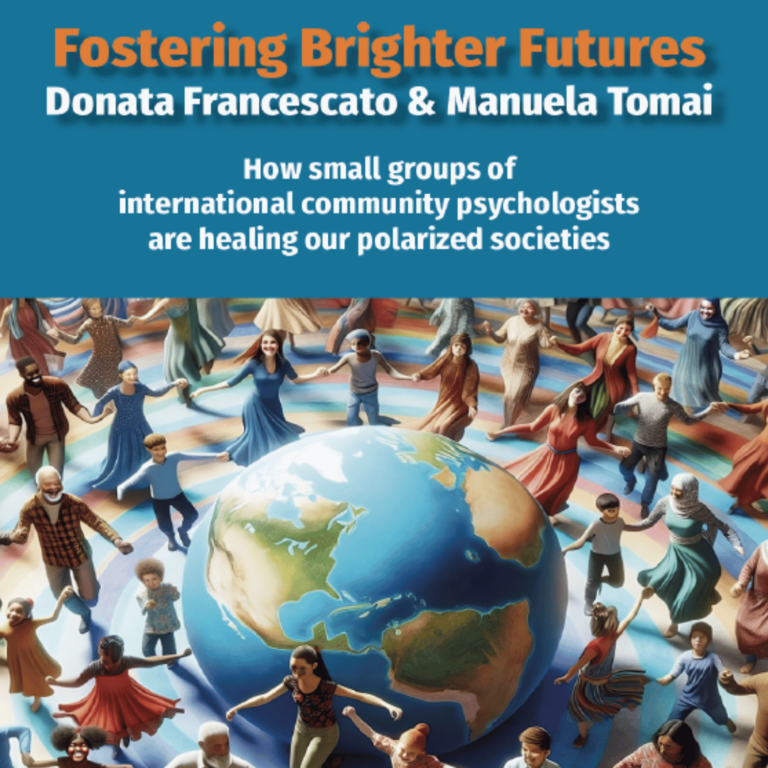
In recent decades I have tried to develop community psychology in Italy and Europe which is now taught in Italy in 40 universities, but is much less widespread than psychotherapy, I think that in the era of individualism we need to support the “we” and develop a sense of planetary community to save our small planet. With Manuela Tomai we have written a Handbook of Community Psychology (2023) that presents the values and theories of moderate and radical psychologists from the North and South of the world, and explores the relationships between clinical and community psychology. Then we describe the methods: how to develop the sense of community, social networks and social support, how to implement community profiles, how to make organizations and associations more empowered with Participatory Multidimensional Organizational Analysis, how to use small group and self-help groups, how to network, empowering training, socioaffective education, participatory action-research, evaluation of intervention programs and how to reduce climate change.
In the final part, clinical and community psychologists of different generations tell their professional stories that fascinate like novels, surprise for the variety and multiplicity of experiences, and document a heritage of creativity, passion and satisfaction that increases the hope and joy of working together with the psychotherapists who promote the Assisi Manifesto.
I hope you find something that intrigues you.
Donata Francescato
News

LIBRI


ACCESSO UTENTE
Vuoi farmi delle domande?
Whether you’re curious about features, a free trial, or even press, we’re here to answer any questions.